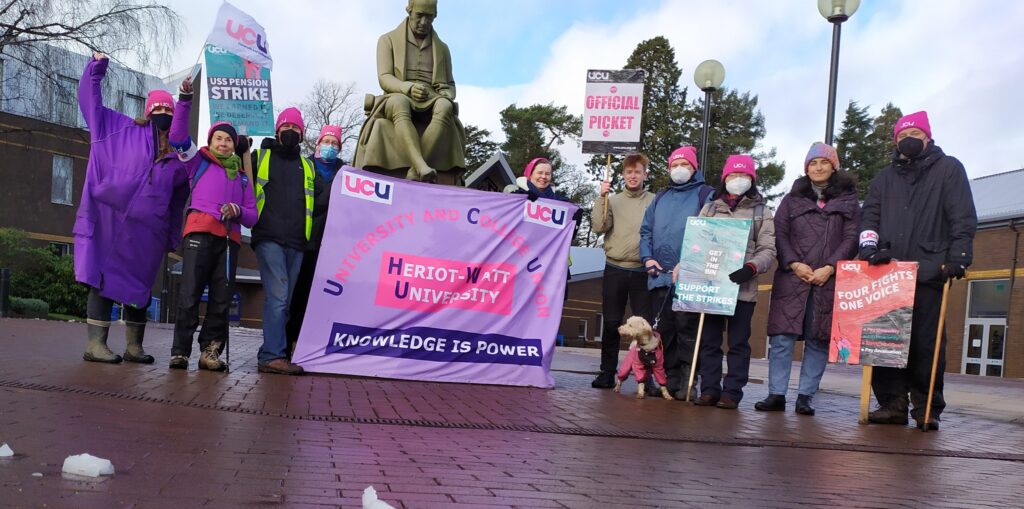
Some of our hardy Heriot-Watt UCU branch pickets brave the cold as James Watt looks on.
End of week 1 and despite it being half term with many staff away on leave observation of strike action has been very good so far. Please keep it up. We need to send a strong message to our employers if we want to stop these irresponsible cuts to our pension benefits. Pensions which we have earned and which we deserve.
Please continue to observe the industrial action next week on the 4 Fights. Visit the picket line if you can. Picketing is the face of the strike, where we congregate at an agreed location to protest visibly and try to persuade our colleagues to join the strike. You can be on strike without picketing and the law on industrial action protects striking staff from victimisation for not doing work when on strike.
If you are unsure about what taking action involves and what it might mean for you please contact a member of the branch committee, or just pop down and ask. We will be outside the main entrance from around 8am until 10.30am each morning.
There was a great turn out of staff and students on the first day of strike action even though it is reading week and the half-term holidays.
We will all be back again tomorrow and every day for the rest of this week, fighting to save all of our pensions. Please come along and join us if you can. We may even manage a celebrity visitor one of these mornings.
From the beginning of next week there will be further strike action to defend against deteriorating pay and working conditions.
If you can’t join a physical picket line you can drop into one of our online pickets. The first one is Tuesday 15 February at 9.30. Please check you inbox for details.
Strike action over pension cuts, pay and working conditions will begin on Monday.
Those who take part do not take this decision lightly, a day’s pay is sacrificed for each day of participation. However, if we don’t fight we stand to lose more. Up to a third of our pension on retirement; a continuing real value reduction of take home pay in face of soaring inflation; an increase in pressure and stress caused by unrealistic and unmanageable workloads, jobs and job security as more and more staff and services are casualised and outsourced; and the shameful failure to close gender and ethnic pay gaps across the sector.
Previous strikes have saved the defined benefit portion of the USS pension scheme, and more recently saved jobs when compulsory redundancies were threatened locally in 2020.
You do not have to be a member of a union to take part in industrial action and had have your voice heard, but it is advisable. Being part of a recognised collective bargaining group comes with benefits and protections. If you would like to join the UCU you can do so at https://heriotwatt.web.ucu.org.uk/how-to-join/ . It only takes a few minutes, it doesn’t cost much, and your subscription will be eligible for tax relief.
Joanna Cherry QC and MP for Edinburgh South West visits the picket line #OneOfUsAllOfUs
While many of us were still in bed Joanna Cherry QC our local MP for the Edinburgh South West constituency was up and about meeting the early birds on the picket line. The university is one of the biggest local employers and we want to see it commit to the community that serves it by undertaking to tackle insecure contracts, pay erosion, work-induced stress, gender pay gaps, and poverty in retirement. You know it makes sense.
A big thank-you Joanna. It means so much that you stand with us. Solidarity.
…and not to be upstaged, Daisy the dog still means business too #hwucupickets
When you return to work you should declare truthfully if you have taken part in strike action. It can be entered in ERP as unpaid leave. From Monday members will be working to contract on Action Short of Strike. This means that we work to the hours stipulated in our contracts. You do not have to declare to anyone that you are working ASOS, or enter it in ERP. Just don’t do all those extra hours that you have been doing for free. Our employers may have grown to expect it, and even more so during the current covid crisis, but think about whether they are demonstrating that they value your efforts.
Thank-you all those hardy souls who visited the picket line this morning despite the freezing weather, and thank-you too to all of you on strike at home who zoomed in from the virtual picket.
If you didn’t catch it live, you can still watch the Scotland-wide national rally at https://www.youtube.com/watch?v=buT2_l6PI1o. Outstanding speeches, in particular from Matt Crilly, NUS Scotland President (approx. at 26:00) and Steve Reicher (approx. at 31:00) – they are a must watch!
Tomorrow is the last strike day in 2021. Time to show our bosses that they need to agree to address deteriorating pay, inequalities, excessive workloads, and creeping casualisation
Join us at the main entrance from 8.30 – 10.30am and lets make it a big one.
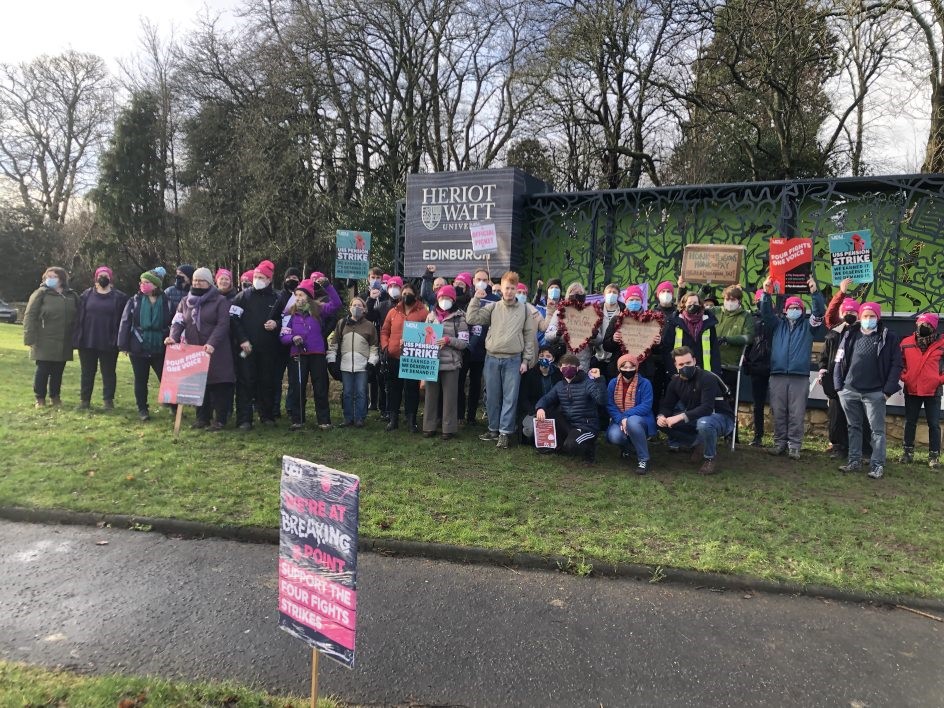
Around 50 staff and students joined the picket line this morning, and other branches has similarly lively picket lines. We are striking to improve pay and working conditions for all members of staff, and also to preserve pension benefits for all members of the USS scheme.
We will be at the main entrance from 8.30 am to 10.30 on Thursday and Friday too. Please drop by and show your support.
Due to concerns over the spread new Omicron variant the strike rally planned for tomorrow outside the Scottish Parliament has been moved online. You can still show your support and solidarity by joining us for the live stream on YouTube or Facebook.
Speakers include NUS Scotland president Matt Crilly, UCU Scotland president Lena Wånggren, Independent SAGE expert and UCU member Prof Steve Reicher, plus politicians and activists straight from the picket lines.
Members of the Student Progressive Society join the picket.
We were thrilled to have members of the Society of Progressive Students join us on the picket line today. The Society is committed to raise awareness of ongoing issues and to promote student engagement and discussion.
It is great hear that we have so much support from our students. Our working conditions are your learning conditions and together we make our universities what they are.
Heriot-Watt is one of 58 universities where staff, having voted overwhelming in favour of industrial action, are poised to strike over pay, pensions, and working conditions. The first of these strikes will be from Wednesday 1 December to Friday 3 December.
What is a strike?
A strike is when, as a result of unacceptable working conditions, members of a trade union collectively refuse to work. Instead, they gather outside their workplaces to protest; these gatherings are called picket-lines.
How are strikes meant to work?
Strike action is the last resort workers have when negotiating with their employers. It’s not something anyone treats lightly. Unions have to meet stringent requirements to declare a strike; meanwhile, striking workers lose their pay, often suffering significant hardship as a result. But it’s a tried and tested way of protecting and improving working conditions.
What are the strikes supposed to achieve?
A modest pay-rise – to match inflation and start making for up years of cuts. It has been estimated that staff pay has fallen by 20% in real terms in the last 20 years while executive pay has soared. A recent report by the Office for Students shows total remuneration for vice chancellor’s averages £269k. In the last year which they were reported, the annual accounts show that our own Principal earns in excess of £300k. A very generous increase of 27k on the year before, and more than 7 times the average salary at HWU.
An end to precarious employment practises, including zero hour contracts, in universities;
A concrete and binding plan from employers to close the gender and BME pay gaps, and to reduce workloads;
No rises in pension contributions.
Universities say they can’t afford to increase pay. But over the past ten years, the proportion of revenue they’ve spent on staff has fallen, while spending on flashy buildings has soared. That’s where your tuition fees are going – to university vanity projects, not to the people who teach and support you.
How will I be affected?
During the strikes, lectures, seminars, classes and demonstrations organised by your faculties may be cancelled. This will cause disruption for students, and the university will blame it on striking staff. However, they and their representative bodies, UUK and UCEA could have avoided the strike but chose not to act. Entrances to the campus will have picket lines at them. This will not prevent you from entering the campus if you want to but we would appreciate it you show solidarity and come and visit the picket.
So, why should I support the strikes?
Worsening conditions in higher education affect us all. Your teachers’ working conditions are your learning conditions. Staff don’t want to go on strike: they’d much rather be teaching, researching, providing services and support, and doing the work they love. In fact, strikes are a way of making sure they can continue doing what they do. Insecure employment, intolerable workloads, unequal pay, and uncertain futures – all these threaten the future of higher education as we know it. The union is fighting back on behalf of students and staff alike, to build a better and fairer university for everyone.
Research undertaken by the NUS in their monthly opinion tracker survey shows overwhelming support with 73% of students indicating support for the strike action.
Students have a rich history of standing shoulder to shoulder with university staff, who have seen their pensions, pay and conditions slashed in recent years, so I’m not surprised that they overwhelmingly support their campaign to secure a fairer settlement.
With vice chancellors’ average total pay rising to £269,000 per year, it is clear that UUK and UCEA can afford to resolve their dispute with UCU over staff pay, which has fallen by an average of 20% in real terms between 2009 and 2019. Staff teaching conditions are student learning conditions, and moreover many postgraduate students on casualised teaching contracts will be striking. The onus for minimising disruption for students lies with university bosses: they must come back to the table to address the clear issues in how higher education is currently run. This is why NUS have launched a petition of students calling on UUK and UCEA executives to return to the negotiation table and meet UCU’s demands.
– Larissa Kennedy NUS UK President
How can I show my support?
There are plenty of ways you can show your support.
Come and join us on the picket line.
Write to the Principal: tell Richard Williams you back your lecturers and teachers, email him at R.A.Williams@hw.ac.uk
Join the Union. If you are Postgraduate student you can get FREE UCU membership.
Stay informed. Stay informed: for regular updates on the strikes as they progress, keep an eye on our HWUCU Twitter at @UCU_HWUBranch and Facebook @UCUHWU for more information on what’s going on and how to get involved.
When staff and students unite we can make real change happen. By coming together can make a fairer future.
Week two – Monday 24, Tuesday 25 & Wednesday 26 February
Week three – Monday 2, Tuesday 3, Wednesday 4 & Thursday 5 March
Week four – Monday 9, Tuesday 10, Wednesday 11, Thursday 12 & Friday 13 March
Why are Student Unions supporting us?
Student Unions believe firmly in showing solidarity with other unions which fight to make your education better. UCU also represents a large proportion of student members which includes Postgraduate Research students. It is them who, as future academics, stand to benefit significantly from improved working conditions should UCU be successful in this dispute. Student experience will always be better with satisfied staff who are able to teach and support students to their fullest ability. Currently, precarious conditions and a decline in pay exacerbated by gendered and racialised pay gaps do not allow this to happen. You can watch the short video by NUS and UCU here.
What can you do to help?
Let your lecturers know that you support them – it will mean a lot! Keep an eye out for our planned teach-outs at the Student Union and please join in wherever you can.The more that students show their support, the greater the chance that the strike will be successful in forcing universities back to re-enter negotiations and settle the dispute.
The University has published general information relating to the industrial action which can be accesed through Frequently Asked Questions.
Just because teaching staff are on strike, doesn’t mean education has to stop!
HW Student Union is opening its doors in solidarity to let us use their facilities. We will be hosting a series of workshops and presentations on wide range of topics including a special screening of “Who is Europe”.