Dance-offs

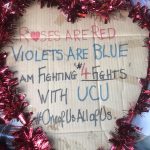
Last morning on the picket for this week and we finished with a dance-off between the Dinosaur of Solidarity and Daisy the dog. At the same time our national negotiators are involved in their own dance-off, negotiating with their counterparts from UCEA at ACAS.

At this early stage the rules and processes will be agreed before discussions on a deal can begin. If we hold fast we give our negotiators a much stronger hand in the bargaining process. We don’t want to strike but we need to strike to keep pressure on our employers so that an agreement can be reached.

Re-ballot

Negotiations can take a while, so it is essential that we re-ballot now to have a mandate for another 6 months of industrial action. The aim is to reach agreement but we need to be able to leverage the threat of continuing strikes and marking and assessment boycotts if we are to get the best deal.

Ballot papers will start to arrive from Wednesday 22 February and more information will follow in due course.

Vote Yes to continuing industrial action in the re-ballot and be in the room with your union.


Half term heroes

A big thanks to the hard core half term skeleton crew of students and staff who  neglected studies and put home lives aside for picket duties today. All those jobs don’t do themselves.

We will be back tomorrow but much more important than the picket is that we keep up the pressure on our employers by staying out on strike until a settlement is reached. On strike days please observe the virtual picket line and don’t work, don’t attend meetings other than UCU teach outs and members’ meetings, and don’t deal with email or Teams conversations about work.

There is no obligation to tell your line manager or anyone else that you are going to participate in strike action. It is university management’s responsibility to explain to students if classes are to be cancelled on strike days but you may wish to talk to your students before any industrial action, explaining why the union is taking this step and asking them to write to university management to voice their concerns. There is a useful UCU explainer leaflet and we have plenty of paper copy too.

We have the support of students, both local and national, and it is important to remember that staff teaching conditions are also student learning conditions. We are in this together on the picket and at rallies, fighting for a fairer education system.

If you would like to participate in any of the Q+A sessions with students we would be very grateful for volunteers. Please check your HW UCU members emails for a link to a poll of availability or contact a committee member. Sessions generally run from 11-11:30am in the Student Union on selected strike days.


The Dinosaur of Solidarity

Valentine’s Day on the picket line with the Dinosaur of Solidarity, and a good time to remember that it is only by acting together that we can change things for the better.

There has been some movement, with talks moving to the Advisory, Conciliation and Arbitration Service (ACAS), but we need to keep the pressure up and show our employers that we are willing to do what it takes, and that we will not be waited out. We remain committed to fighting for fair pay, better working conditions, and to save our pensions.

If you are not already a member, take the first step and join today.

What’s it all about: 4-Fights

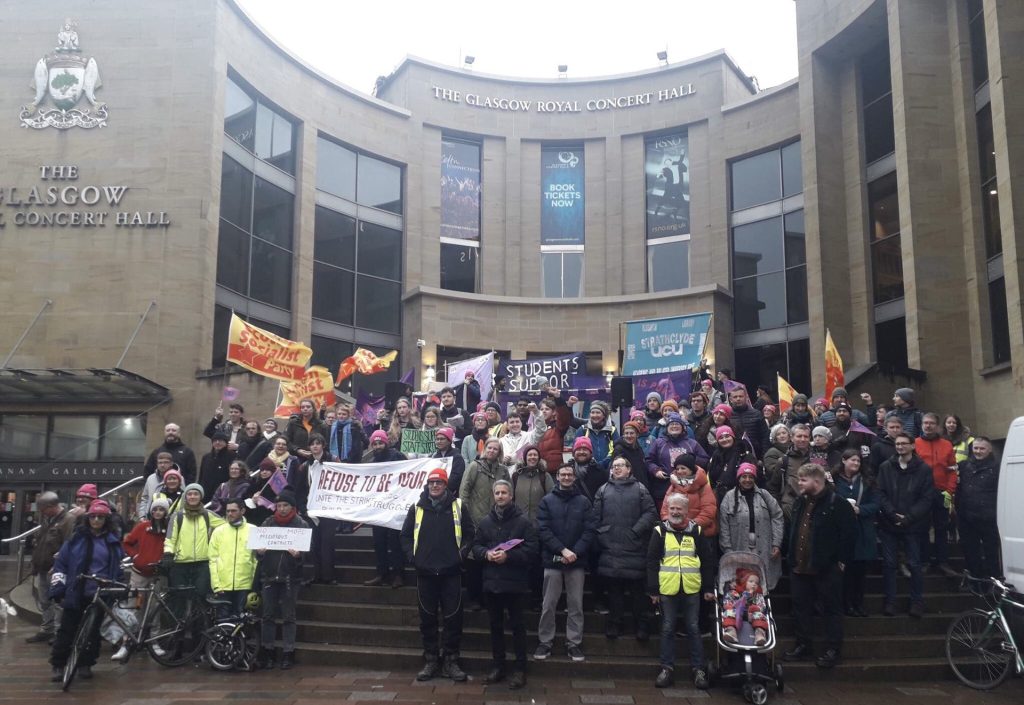
Out of bed early and onto the picket to fight for better pay and working conditions, then through to Glasgow to attend the UCU rally and stand with other staff and students from across Scotland.

Pay and working conditions dispute

The 4-Fights is a national dispute on pay and working conditions. We are asking for:

  • an increase of inflation plus 2% or 12%, whichever is the higher.
  • the elimination of precarious contracts
  • action on gender, ethnic, and disability pay gaps
  • a standard 35 hour week for full time employees with no loss of pay

In May 2022 a pay settlement of 3% was forced on us by our employers. Figures show that we now earn around 25% less than we did in 2009 adjusted for inflation. Our pay demands incorporate an uplift to cover the current cost of living plus recovery of some of this pay erosion. In the latest round of talks UCEA, representing the employers, have made a tiered offer which would see a meagre uplift of only 4-5% for most.

Across the sector around one half of teaching staff are on fixed-term contracts, and two thirds of research-only staff. Despite widespread condemnation many institutions still use zero hour contracts. We are asking for national approach to end these insecure employment practices.

More work needs to be done to tackle equality. There are significant pay gaps between Black and white staff, across genders, and which affect disabled staff. These same groups are disproportionally likely to be on precarious contracts and/or affected unmanageable workloads.

Workloads have soared due to huge class sizes, pressure to secure funding, inefficient IT systems, poor work environments, and the reduction of support through constant cycles of ineffective restructuring. The average working week in higher education is now over 50 hours.

Workload, pay inequality, and insecure contracts are linked. We are forced to do more for less. It undermines our professionalism and affects our health. At the time of writing no commitments have been secured on casualisation, equality, and workloads.

The Principal will say that that every 1% of pay rise increases running costs by £1M and that the university cannot afford it, but 2021 the 5 key management personnel at Heriot-Watt took home more than £1.1M between them. This is the Principal, the Deputy Vice-Principal, the University Secretary, the Global chief Operating Officer and the Global chief Financial Officer. Executive pay costs at Heriot-Watt rose by more than 40% between 2020 and 2021 while staff were offered 0% at the JNCHES national pay negotiations. We seem to be able to afford this.

We can also afford an overspend of around £5M and rising on a catastrophic Oracle ERP project which has so far failed to deliver on anything but the most basic of reporting. And we can also afford to nudge closer and closer to a debt cliff as we borrow to finance vanity projects instead of investing in staff and improving teaching, laboratory, and working spaces – the bricks and mortar of the university in which revenues are earned.

Every year staff are expected to deliver more for less, while the our senior leadership team deliver less for more. We only have to look at staff satisfaction surveys and student feedback to see where the problems lie. We demand better for staff. Fair pay, reasonable workloads, and a safe stress-free workplace that is environmentally sustainable. Join us on the next picket on Valentine’s Day 14 February and help make our employers show staff some love.

If you can’t attend in person please observe the strike. Don’t work. Don’t check your email. Don’t participate in virtual meetings about work. On non-strike days we continue to work action short of a strike (ASOS). This includes: working to contract; not covering for absent colleagues; removing uploaded materials related to, and/or not sharing materials related to, lectures or classes that will be or have been cancelled as a result of strike action; not rescheduling lectures or classes cancelled due to strike action; and not undertaking any voluntary activities.

What’s it all about: Pensions

A busy day started with another great turnout on the picket, followed by a Q&A session in the Student Union, and then later a members meeting with guest speakers Mark Taylor-Batty and Jackie Grant from the UCU team of USS national negotiators.

The next Q&A session at the Student Union will be Tuesday 14 Feb from 11-11.30. This is a great opportunity to engage with our student community. Thank again to our students for your steadfast support, and to Adnan, Juliette, and Wolf.

The pensions dispute

In the Spring off 2020 the Universities Superannuation Scheme (USS) conducted a valuation at a particularly inopportune moment, just as the markets crashed, and used this to claim that to maintain our benefits in retirement contributions would need to rise substantially.

At the time both of UCU and Universities UK (UUK) recognised considerable flaws in the methodology. Unfortunately UUK, our employers’ representative body, decided to push through with cuts instead of challenging the USS valuation.

The cuts significantly affect the income which we can expect to receive in retirement from service after April 2022. It is estimated that 196,000 staff will loose between 30 and 35% of guaranteed income in retirement. This comes on top of cuts applied between 2011 and 2019 which had already reduced a typical retirement pot by £240,000. The cuts also imposed a cap on inflation protection of 2.5%. At the time of writing the Consumer Price Index (CPI) which USS use as their gauge of inflation is around 10%. This means that the future value of our pensions may be doubly impacted by these detrimental changes which were forced through by our employers.

We are demanding that our university Principals / Vice Chancellors retrospectively restore benefits to 2021 levels. The latest data suggests that the scheme is healthy and that the 2020 valuation was excessively pessimistic, and also that monitoring and governance at USS have been poor.

In the Joint Statements agreed for calling off the Assessment and Marking Boycott last summer, the senior leadership team at Heriot-Watt also agreed that the return of improved benefits to staff is a priority and that governance reform is needed.

There have been some movements but our benefits have not been restored. Bill Galvin the CEO of USS has agreed to step down and Guy Coughlan, the architect of the 2020 valuation has left. USS has so far only announced that it aims to improve benefits or reduce contributions by 1 April 2024.

This is simply not good enough, so for now we need to hold the line and keep the pressure on UUK and USS until we have a firm commitment that benefits will be restored to 2021 levels and that all future valuations are moderately prudent and evidence based.

If anyone is new to Heriot-Watt or new to picketing, or doesn’t know anyone on the picket line, please don’t be put off. Picket lines are very welcoming to everyone. Please come and introduce yourself to someone in a yellow high-vis vest and we will make you feel at home in no time.

If you are unable to attend in person please observe a virtual picket. Don’t work. Don’t engage with emails about work, other from UCU. Don’t attend meetings about work except for UCU teach-outs and members’ meetings.

The longer the picket line the shorter the dispute.

Online Members’ Meeting Thursday 9 February

There will be a members’ meeting tomorrow at 2.00pm via Zoom. Our guest speaker, Jackie Grant elected USS negotiator on the JNC, will provide an update on the USS dispute.

Details on how to join the meeting have been sent by email.

It is now time to put your out-of-office on and down tools for another 2 days of strike action. You can see some examples on the UCU website at https://www.ucu.org.uk/Out-of-office or roll your own. Here is one that we prepared earlier:

I will not be responding to work-related emails on Thursday 8 and Friday 9 February, because I will be on strike.

I am taking part in industrial action over pay, working conditions, and pensions. If you are a student, please be patient. I will respond to your email on my return. If you are a member of staff who is in the USS pension scheme but not on strike please note that under the current employer proposals you can expect to lose between 30 and 50% of the projected value of your pension in retirement, and that your pay has been reduced by more than 20% in real terms since 2009 on top of all the extra work which you are expected to do for free.

You can find further information about the disputes at https://www.ucu.org.uk/rising and you can support us by joining the UCU and taking part in the industrial action or by donating to our local hardship fund

Our Students Support the Strikes

Students Support the Strikes

A great turn-out for this first day of the latest wave of strike action. Support and hot drinks provided by our amazing Heriot-Watt Student Union and the Society for Progressive Students. A big thank-you to all.

Last week, Universities and Colleges Employers Association (UCEA) made a new offer in pay negotiations. Unfortunately, it failed to meet our demand for fair pay and better working conditions. Our vice chancellors are getting rich by ripping off staff and students. The fight continues. Next week we will on strike on Thursay and Friday and this action will continue to escalate until our employers come back with a fair offer.

If you have been affected by the strike action please write to the Principal and ask that he use his considerable influence to ensure that we all get treated fairly.

Next wave of strike action announced

The first day in the next wave of strike action will be Wednesday 1 February, timed to coincide with TUC day of action aimed at defending our right to strike.There will be a picket from 8-10.30 am at the main entrance to the campus.

Lets make it the biggest picket Heriot-Watt has ever seen. The longer the picket line, the shorter the dispute.

The full list strike days announced fall as follows:

  • Week 1 – Wednesday 1 February
  • Week 2 – Thursday 9 and Friday 10 February
  • Week 3 – Tuesday 14, Wednesday 15 and Thursday 16 February
  • Week 4 – Tuesday 21, Wednesday 22 and Thursday 23 February (paused during ACAS)
  • Week 5 – Monday 27 and Tuesday 28 February and Wednesday 1 and Thursday 2 March (paused during ACAS)
  • (No action week commencing Monday 6 March)
  • Week 6 – Wednesday 15 (new date), Thursday 16 and Friday 17 March
  • Week 7 – Monday 20, Tuesday 21 and Wednesday 22 March.

Some of the dates fall into our reading week but there are always plenty of additional tasks landed on our hardworking staff during this week, and professional services work as usual.

Taking Part in Strike Action

You do not have to tell your line manager or anyone else in advance whether you will participate in strike action. Heriot-Watt will circulate details on how and when to record strike action in the ERP system in due course.

Whether you tell your students that you will be on strike is up to you. The purpose of strikes is to create maximum disruption so that the employer returns to the negotiating table with an acceptable offer. Please encourage students to make their views about cancelled lectures known to the Principal. The Student Union supports our action.

We don’t want to strike, we don’t want to lose part of our salary. But we are forced to fight for our pay, pensions and better working conditions. There is a solution but our leadership are unwilling to make a fair offer. They are failing our staff and our students.

The Cost of Striking and Strike Pay

If you think you can’t afford to strike, as yourself whether you can afford the reduction in your pension, the year on year erosion of your pay adjusted for inflation, and all of the extra work which you effectively do for free.

The net cost of striking is often lower than you think and financial support is available from the national fighting fund and the local hardship fund.

Action Short of Strike (ASOS)

We remain in ASOS in the form of working to contract. Members should:

  • only fulfil the duties explicitly expressed in your contract
  • not undertake voluntary activities
  • not cover for absent colleagues
  • refuse to reschedule classes missed due to industrial action
  • remove materials for classes that would have taken place on strike days from online learning platforms

As things stand there will be no deductions for this form of ASOS at Heriot-Watt.